Balingup Rail Group (BRG)
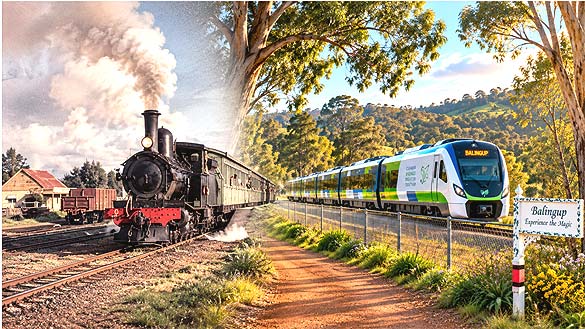
Train on left "Leschenault Lady" Vintage Train c.1970) Original Photo: J Joyce; Rail Heritage,T04513
Balingup Rail Group: Feasibility Study, Cultural Tourism, Commuter Services and the Future of South West Rail

Establishment of the BRG
BRG was formed by the Balingup Progress Association Inc. (BPA) in 2018 to examine and report on two significant issues:
First, use of the South West rail line for the transport of lithium concentrate produced in proximity to the line at the Talison Lithium mine at Greenbushes and, second, the possibility of establishment of a tourist/commuter passenger service on the line between Bunbury and Bridgetown.
The first issue arose from the public complaints against the unacceptable and unsustainable constant heavy haulage of the lithium ore by large trucks through Balingup.
The second issue reflected a community understanding that if use of the line were to become available a tourist and commuter passenger service would be a necessary addition given that it is a very scenic section of railway and historically attracted many tourists on rail excursions to this part of the South West.
In effect, the tasks assigned to it by the BPA required BRG to examine how the under-utilisation of an important State asset, namely the South West rail corridor, could be redressed.
The outcome of this work has been the development of a proposal for a modern, zero-emissions, battery-electric passenger rail service capable of producing multiple benefits:
- tourism development;
- commuter and regional mobility;
- regional economic dividend;
- access to regional employment, health, education, and professional services;
- passenger comfort and safety;
- reduction of traffic congestion and improvement of road safety;
- maintenance of the unique character of the towns on the line; access to multiple attractions produced in or near those towns. See Cultural Tourism Document
and Feasibility Study Document
Acceptance of the BRG proposal would restore the role of the railway as infrastructure for sustainable and long-term social, economic and environmental development of the South West. It follows from the above that resolution of the first issue, transfer of the transport of lithium ore from road to rail, is, in part, subsumed in achievement of the second.
At that point, with a freight-ready rail line near the mine, the transfer of the Greenbushes lithium product from road to rail for the purpose of reducing emissions from the use of diesel; reducing the use of diesel; improving road safety; reducing traffic congestion; restoring residential amenity; and reducing damage to the roadway of South West Highway, would be usually beyond argument.
From Community Input to Feasibility Study
BRG released the Feasibility Study in August 2024 after conducting community meetings and detailed investigation. Working with local government, industry and government agencies, BRG has pursued the potential reopening of the rail corridor for passenger, commuter and cultural tourism services, while continuing to recognise the potential role of rail freight in reducing the heavy-vehicle burden on the South West Highway.
A significant step was commissioning international rail experts Linqage to develop the business case into zero-emissions tourist and commuter services between Bunbury and Bridgetown.
The study examined the infrastructure, operating model, rolling-stock requirements, economic potential and wider regional benefits of restoring passenger rail to the corridor.
Financial support for this work was secured from the City of Bunbury, Talison Lithium, BPA, and the four local authorities affected by the rail line, Bridgetown-Greenbushes, Donnybrook-Balingup, Capel, and Dardanup.
The WA Government's Freight Rail Buyback Announcement — September 2026
The Western Australian Government's announcement on 15 September 2026 regarding legislation to progress the proposed freight rail buyback represents a significant development in the strategic policy context for Western Australia's rail infrastructure.
The Cook Government announced the introduction of the Rail Freight System (Acquisition and Reorganisation) Bill 2026, establishing a legal framework for the potential acquisition of the State's freight rail operation and the return of the freight rail network to government control, subject to economic, financial, legal and technical assessments. Commercial negotiations with Brookfield continue, and Arc Infrastructure remains responsible for operating the network under existing arrangements during the ongoing process.
The announcement identifies the strategic importance of the freight rail network to regional communities, local jobs, economic development and supply-chain resilience. It also recognises the potential for greater public control to support targeted investment, increase rail network utilisation and improve the movement of commodities between regional industries and markets.
Of particular relevance to the objectives pursued by BRG and the Balingup Progress Association is the Government's stated interest in reducing truck movements and the wear and tear caused by heavy vehicles on local roads, while strengthening regional infrastructure and supporting future employment.
The announcement provides a broader policy context for continued consideration of the future of the South West rail corridor. It does not, in itself, determine the future of the Bunbury–Bridgetown passenger railway or establish a commitment to reopening the line for passenger services. However, it reinforces the strategic significance of rail infrastructure in addressing freight efficiency, road safety, regional connectivity and long-term economic development.
For BRG, the announcement creates an opportunity to continue presenting the potential relationship between freight rail, zero-emissions passenger services, commuter mobility and cultural tourism. The feasibility work and prospectuses developed by BRG and BPA provide a foundation for consideration of how existing rail infrastructure might contribute to a more integrated, sustainable and accessible South West transport network. See WA Government Announcement
For the Bunbury–Bridgetown corridor, this technological development creates the prospect of reopening a non-electrified railway without the capital cost and infrastructure requirements associated with conventional overhead electrification. It also provides an opportunity to consider quieter, cleaner and lower-emission passenger services using technology increasingly being deployed internationally. SeeThe Global Evolution of Battery Passenger Rail 2021-2026
BRG's Proposal Not Confined to Tourism
A restored passenger railway could provide a valuable commuter and regional mobility service, connecting communities along the corridor with employment opportunities in Bunbury and other regional centres, as well as education and training, health, aged-care and community services. Bunbury is the major regional health centre, with the South West Health Campus providing a wide range of hospital, specialist and community health services.
Improved rail connectivity could therefore contribute to regional employment participation and workforce mobility while providing an alternative to private-car dependence for residents who do not drive, older people, young people and others requiring access to essential services. The potential is particularly significant where employment, education, health and community services are concentrated in larger regional centres.
Cultural Tourism A Major Driver for the Future of the South West of WA
Alongside the engineering and economic feasibility work, BRG has developed a Cultural Tourism Prospectus to demonstrate the wider tourism proposition created by reopening the railway. The prospectus positions the Bunbury–Balingup–Bridgetown corridor as a distinctive South West cultural tourism route, connecting communities, landscapes, heritage, food, arts, events and major regional attractions through a sustainable rail experience.
The prospectus also considers the potential to connect the corridor with the wider South West visitor economy and to strengthen the economic contribution of tourism to the towns and communities along the line.
The railway is therefore conceived not simply as a transport project, but as enabling infrastructure for tourism, employment, regional connectivity, community access and economic development.
A Cultural Prospectus presents the full strategic case for the evolution, feasibility and future potential of battery-electric passenger rail in Western Australia, bringing together global technology developments, economic and infrastructure considerations, international case studies, the Bunbury–Bridgetown Stage 1 proposal, future extensions to the South West, regional connectivity and tourism opportunities, and the policy and investment context for a cleaner, more connected rail future. See Cultural Tourism Document
Advocacy with Government Industry and Community
BRG has presented its feasibility work to relevant government, transport and regional development authorities and has continued discussions concerning the future use of the rail corridor. The work undertaken by BRG and BPA has established a substantial body of feasibility, tourism and strategic material to support consideration of the proposal by local, State and Commonwealth governments.
The underlying proposition is a staged transformation of an underutilised rail corridor into a modern passenger railway capable of serving several purposes: commuter and regional mobility, access to employment and essential services, cultural and tourism travel, and potentially future freight. In doing so, the railway could become an important piece of enabling infrastructure for the long-term social, economic and environmental development of the South West.